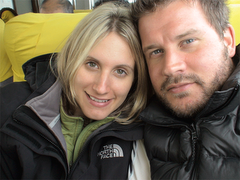
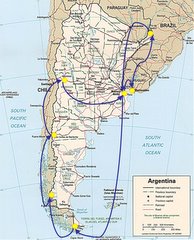
Here are some videos of Antarctica.... the first is from Neko Harbour where there was a penguin 'swimming pool' and nursery....
The second is from Paradise Harbour, our last trip on a zodiac before we headed back to Suth America, and we were visited by a very inquisitive Leopard Seal...
And this one is of Elsehul Harbour on South Georgia...
Monday, April 02, 2007
Thursday, March 22, 2007
March 13 to 16: Buenos Aires and home
Well we're home now. After Iguazu we stayed for a couple more nights in Buenos Aires before flying home.
The trip was incredible and to anyone thinking of visiting the Antarctic or Argentina - just do it!
Tuesday, March 20, 2007
March 6 to 10: Uruguay
We then flew to Uruguay for a few days. After a couple of days relaxing in Punte del Este, one of South America's best beach resorts (which we enjoyed despite the rain!), we travelled to the capital, Montevideo.
However, just beforehand we learnt that George Bush had similar ideas to visit the city as part of his whistle stop tour of South America but also to stay at the same hotel as us! We had been advised that the hotel was big enough to cater for both of us (to our surprise) but on arrival, having hauled our luggage through the various security gates to the hotel (surrounded by military and secret service), the reception kindly informed us that they had wrongly advised us and that we were being evicted! However they did move us to another hotel and we then set off to explore what we could off Montevideo despite the convoys for President Bush, Condoleeza Rice and a few thousand protesters......


However, just beforehand we learnt that George Bush had similar ideas to visit the city as part of his whistle stop tour of South America but also to stay at the same hotel as us! We had been advised that the hotel was big enough to cater for both of us (to our surprise) but on arrival, having hauled our luggage through the various security gates to the hotel (surrounded by military and secret service), the reception kindly informed us that they had wrongly advised us and that we were being evicted! However they did move us to another hotel and we then set off to explore what we could off Montevideo despite the convoys for President Bush, Condoleeza Rice and a few thousand protesters......


Wednesday, March 07, 2007
3 to 6 March: Mendoza
Mendoza is Argentina's most famous and important wine region. It is an attractive city, with the snow capped Andes acting as an impressive backdrop to both it and surrounding bodegas (wineries).
We eventually reached Mendoza via Buenos Aires from Bariloche and whilst not the most direct route, it was definitely worth it.
We were lucky enough to arrive on the main evening of Argentina's most famous wine festival - just as soon as we had arrived at the hotel we were back out the front door in a taxi to 'Vendimia 2007'(http://www.vendimia.mendoza.gov.ar/vendimia/). We managed to buy great tickets from a tout that sat us 20 rows from the front and next to the press, in the packed stadium for 20,000 with another 30,000 sat outside on the hills. The show told the story of the history of the region and the story of the annual wine harvest, finishing with a Miss Vendimia 2007 contest (Miss Grapes?).
We also visited 3 of Mendoza's wineries in Lujan de Cuyo and Maipu which was great fun- hic!


We eventually reached Mendoza via Buenos Aires from Bariloche and whilst not the most direct route, it was definitely worth it.
We were lucky enough to arrive on the main evening of Argentina's most famous wine festival - just as soon as we had arrived at the hotel we were back out the front door in a taxi to 'Vendimia 2007'(http://www.vendimia.mendoza.gov.ar/vendimia/). We managed to buy great tickets from a tout that sat us 20 rows from the front and next to the press, in the packed stadium for 20,000 with another 30,000 sat outside on the hills. The show told the story of the history of the region and the story of the annual wine harvest, finishing with a Miss Vendimia 2007 contest (Miss Grapes?).
We also visited 3 of Mendoza's wineries in Lujan de Cuyo and Maipu which was great fun- hic!


Monday, March 05, 2007
1 to 3 March: Bariloche
After El Calafate we flew to Bariloche, the Argentine Lake District. Beautiful surroundings, with the region's largest lake, Lago Nahuel Huapi, lapping at the shoreline of our Hosteria. We spent the first day here relaxing but we were intent on one major trek.... so we decided to trek to the top of Cerro Lopez and its quaint but very necessary pink Refugio. At 2,000m, the reward for our efforts were the spectacular views throughout our climb. We slept particularly well that night!!


Orcas and Penguins!!!
Orcas pack hunting a Minke whale on day 13, Antarctic Peninsula
King Penguins, Salisbury Plain, Souh Georgia
Gentoo penguins, Antarctic Peninsula
Rockhopper Penguins, Falklands
King Penguins, Salisbury Plain, Souh Georgia
Gentoo penguins, Antarctic Peninsula
Rockhopper Penguins, Falklands
Monday, February 26, 2007
23 to 28 February - Ushuaia and El Calafate


What are we doing now? Apart from Antarctic dreaming, we had a couple of days R&R in Ushuaia and then moved on to El Calafate, slightly further north in Argentinean Patagonia. We're staying in a place called Los Notros (www.losnotros.com) and it is beautiful - the only lodge in the Parc Nacional Los Glaciares, with a stunning view from our room across to the Perito Moreno Glaciar.
So far we've been walking with crampons out on the glaciar, walking and trekking.
Sunday, January 21, 2007
Days 17 to 19 (22 February 2007): At Sea, Drake Passage back to Ushuaia
We have been incredibly lucky with the weather on our journey so far, and it seemed appropriate that this would change.
“An Antarctic expedition is the worst way to have the best time of your life” – Aspley Cherry Garrad (‘The Worst Journey in the World’)
The Vavilov was thrown around like a cork for the best part of our return journey crossing the Drake Passage, in huge storm force 11 gales (with 55-60 knot winds) and 7m swell. Amazingly, we were fine, having now got our sea-legs. Ending our experience with a fitting Captains dinner, we thanked our Russian captain for keeping us safe on the return journey.
And a BIG thank you to all the fantastic Peregrine crew!
A Tribute to Sailors From Days Gone By
by Sara Vial
(Translated from Spanish as written on the albatross monument at Cape Horn)
I am the Albatross that waits for you.
At the end of the earth
I am the forgotten soul of the deceased sailor
Who crossed Cape Horn
From all the seas of the world.
But they did not die in the furious waves.
Today they fly in my wings to eternity
In the last trough of the Antarctic winds.
“An Antarctic expedition is the worst way to have the best time of your life” – Aspley Cherry Garrad (‘The Worst Journey in the World’)
The Vavilov was thrown around like a cork for the best part of our return journey crossing the Drake Passage, in huge storm force 11 gales (with 55-60 knot winds) and 7m swell. Amazingly, we were fine, having now got our sea-legs. Ending our experience with a fitting Captains dinner, we thanked our Russian captain for keeping us safe on the return journey.
And a BIG thank you to all the fantastic Peregrine crew!
A Tribute to Sailors From Days Gone By
by Sara Vial
(Translated from Spanish as written on the albatross monument at Cape Horn)
I am the Albatross that waits for you.
At the end of the earth
I am the forgotten soul of the deceased sailor
Who crossed Cape Horn
From all the seas of the world.
But they did not die in the furious waves.
Today they fly in my wings to eternity
In the last trough of the Antarctic winds.
Days 15-16: Antartica
There have been so many Antarctic highlights;· Watching as humpbacks fed on krill, opening their huge mouths in giant gulps before squeezing the water out through the baleen sieves and diving, raising their huge flukes before disappearing.
· Our landing onto the Antarctic Continent led to a greeting by fur seals, who made it clear to us that this was their land. It was a celebration and felt special that we had made it to the Antarctic Continent.
· Interacting with the penguin colonies in Antarctica and setting foot onto Antarctic land. We had the pleasure of watching the behaviour of and interacting with one of our favourite penguins – the Gentoos! Adorable is the first word that springs to mind, particularly as we were also surrounded by 100s of chicks too! Every penguin has its own character and can behave in an hilarious fashion, chasing one another, squabbling or just lying flat on their front sleeping! We often thought they displayed many human like characteristics. The chicks in particular were highly inquisitive, which was lucky for us, as we had the amazing experience of sitting in snow in what we called “the penguin baby crèche”, just waiting for a chick to come to say hello. They liked to peck our boots, our legs and gloves and Chris was lucky enough to have one lay on his legs momentarily. Other than that, these fluff-balls would just look you in the eye, which was a heart-warming experience. At one point we felt like traitors as we rushed to see a leopard seal tossing a penguin in the air only metres from the safety of our zodiacs, but then, this is nature….and the leopard seals have to eat too!
· Visiting Paradise Harbour on our last day and watching as huge blocks of ice carved away from the immense 40-50 high glacier fronts into the sea, creating giant tidal waves that sent us bobbing over the place in the zodiacs. On our way back, we came across a curious leopard seal in the water, who then circled us, his big black eyes piercing into our zodiac.
But one aspect of Antarctica that it would be great to bottle is the peace and quiet and the morning and evening light – just amazing. Antarctica is truly a pristine continent, the beauty of which words cannot do justice.


Day 13: Antarctica
It is difficult even to attempt to describe the beauty of Antarctica but the scenery is simply stunning. The Antarctic Peninsula’s mountainous, ice covered landscape with awesome glacier formations, seems to change almost by the moment in the varying light and weather. It is incredibly tranquil, with placid water with soft yellow and pink hues, only disturbed as we travelled through the water in the zodiacs.
In the four days we spent on the Antarctic Peninsula, we visited several different bays and natural harbours, making landings on the Antarctic continent; including Antarctic Sound, Graham’s Passage, Charlotte’s Bay and Portal Point, Neko Harbour, Cuverville Island, Curtiss Bay, Mikkelsen Harbour, Wilhelmina Bay and the Gerlache Straits.
On the first night we had anchored just south of Paulet Island and in the morning we went for a zodiac cruise. This proved to be one of the most memorable events of the trip. We had spent the morning in the zodiacs looking at a huge 5k wide tabular iceberg broken away from the Ronne Ice Shelf.
We were the first Zodiac back to the Vavilov and we both went straight to the top deck to continue to look around. Within a minute we had spotted Orcas (killer whales) and hundreds of birds in an apparent feeding frenzy, about 750m away, 8 o’clock to the ship’s lie.
We frantically shouted down and sent those zodiacs still out motoring over to the scene and we shortly joined once we had got back into a zodiac. What appeared to be a few Orcas from a distance turned out to be a pod of 12 Orcas collectively pack-hunting a Minke whale at about 15 knots, gradually tiring out the Minke by jumping on top of it and pushing it under the ice. It also became apparent that this was also a training exercise as the larger Orcas watched as the younger Orcas played the lead role in the hunt.
We stayed with the chase for over an hour, watching as another pod of Orcas in the vicinity joined the hunt. All in all, we were in the midst of 20 orcas and were so close at certain points that an orca actually dived under our zodiac.
Eventually we had to give up as the Orcas moved away under the ice. The Minke was already clearly tired (it would normally be able to outpace an Orca in open water) and would not have lasted too much longer; although we did not see the conclusion, we had witnessed one of nature’s amazing spectacles.


Day 12: At Sea and Arriving in Antartica
In the evening of day 12 we reached our destination, Paulet Island, in good time and so we ventured out for our first Antarctic zodiac ride. This will always hold a particularly special place in our memory, as it was the first time we launched our zodiacs into Antarctic waters for 2 hours in the evening. In the beautiful evening light, we were in awe of this pristine landscape, with amazing wildlife scattered amongst the ice, including our first close-up sighting of a leopard seal.For those who know the Shackleton story, Paulet Island was the point Shackleton tried to reach in the Endurance after giving up on reaching the South Pole. However the ship was caught in ice flows and they could only watch as they saw the Island pass in the distance, unattainable, before the Endurance was crushed under the immense pressure of the encroaching pack ice – the start point for the remarkable story. Paulet Island gave us our first close up views of Adelie Penguins, the awesome Leopard Seal, with its distinctive, predatory face, and the Weddell Seal and Crabeater Seal, which in common with penguins and krill, form part of the Leopard Seal diet.


Days 10 and 11: At Sea
En route to Antarctica we anchored in the South Orkney Islands and visited the Argentinean Antarctic base at Orcadas, where we were shown around the station and research facilities by the military staff – they were incredibly hospitable but then I’m sure anyone would be if you have to spend 12 months in complete isolation! A bit random but interesting nonetheless!


We were very lucky with the weather conditions, and on the afternoon of the twelfth day the ice conditions permitted us to sail through the Weddell Sea amongst huge tabular ice bergs, in blue and white hues, broken off from the ice shelves closer to the continent (Ronne Ice Shelf and Filchner Ice Shelf). Scattered amongst these were smaller ice bergs each in their own twisted form. Every now and then an ice flow would pass by with a single or group of penguins, or seals – be they Fur seals, Weddell seals, Crabeaters or Leopard seals. The Weddell Sea would offer our only opportunity for spotting Emperor penguins and everyone spent the afternoon and evening out on deck watching the passing spectacle, with one eye keenly watching for passing whales, seals and the entourage of birds that had been accompanying us. And then we spotted a juvenile Emperor penguin, albeit from a distance, which cut a solitary figure amidst the passing icescape.


Day 9: South Georgia
We arrived onto Gold Harbour amongst rays of sunshine, and this was a real highlight of our trip to South Georgia. It is often described as being the “jewel in the island’s crown”, which is no wonder in view of the dramatic mountain scenery and hanging glacier. As always, we were greeted onto the beach by inquisitive king penguins and a couple of fur seals, looking for a fight! This island is also home to elephant seals, huge beasts that can weigh up to 4 tonnes…so you definitely wouldn’t mess with them!We also had the pleasure of meeting some gorgeous little penguins, called Gentoo penguins, which waddle around like little balls of black and white fluff and are really adorable. Giant petrel and light mantled sooty albatross are also an amazing feature here, magnificent birds. Our afternoon zodiac cruise to Cooper Bay was wet and windy, but we were still able to have the pleasure of seeing some macaroni penguins hopping on the rocks and of course lots more fur seals, who like to raise their heads from under the water to take a look at what we are doing.


Labels:
albatross,
elephant seal,
fur seal,
Gentoo,
king penguin,
light mantled,
penguins,
sooty,
South Georgia
Day 8: South Georgia

A 6.30am zodiac ride to Fortuna Bay, with a spectacular mountainous backdrop and glacier, gave us the opportunity to sit again amongst king penguins and fur seals, including lots of young pups, who often tried to attack…in a playful way – although if you didn’t stand firm and clap your hands you would get a nasty bite!In the afternoon, the Vavilov took us via Leith and Stromness whaling stations – inaccessible due to a 200 exclusion zone due to asbestos pollution before we moved on to Grytviken. Even from a distance you could see and imagine the scene of operational whaling stations (which was still working up until 1966).
Visiting Grytviken, an old UK whaling station, really brought home the reality of what we humans did in the 1900s to wipe out 100s of thousands of whales and seals to drive them to the point of extinction. Seal numbers in South Georgia have now recovered and the Islands abundance of fur seals, for example, (c 4 million) now represents 95% of the world’s fur seal population. However, the depletion of the world’s whale population at present remains a legacy of human interference in the ecosystem of the Southern Oceans.
Grytviken is also home to the grave of Shackleton and the museum gives a fascinating insight into the history of his epic voyages and the sealing and whaling history of the island.


Day 7: South Georgia


We woke to our first sight of icebergs in the Southern Oceans, snow and an ominous sky – welcome to South Georgia. South Georgia is often called the “gem” of sub-Antarctic waters, due to its abundance of wildlife that cannot be surpassed with its awesome mountain and glacier scenery. South Georgia is also claimed by the UK and the island played an important role in the development of Antarctic exploration.
The island is exceptionally rugged and amazingly beautiful. On our first day, we explored Elsehul (one of the original Norwegian Whaling Stations) by zodiac, seeing huge numbers of fur seals, king and macaroni penguins. In the afternoon, we took to Salisbury Plain in the Bay of Isles, which is really indescribable – a unique penguin colony, where there are over 500,000 king penguins.
Days 5 and 6:At Sea


Albatross watching, constant vigil for whales and fur seals that crossed our route and several optional presentations, listening to experts talk about the birdlife, marine biology of sub Antarctic and Antarctic waters, famous explorers, including Cook, Shackleton, Scott, Amundsen amongst lots of wildlife talks too, which were well worth it.

Day 4: Falkland Islands

The winds persisted but overnight we had made our way down the east coast of the east island to Bleeker Island. After breakfast we boarded the zodiacs and made our way to shore accompanied by playful Commersons’ dolphins. If Stanley seemed barren, Bleeker Island was pure desolation. One farmer and his family occupy the island a Ruddy Headed) and more penguins – Magellanic Rockhopper and Gentoo.Bleeker is a key place for viewing Rockhoppers as they are difficult to see elsewhere with ease (especially given our planned route). And well worth the visit too, to see these cracking little fellows who were happy to carry on hopping about their ways, completely oblivious to the crowd of camera wielding visitors stood but a few metres away!
Unfortunately the wind picked up in the afternoon and so rather than visiting Sea lion Island as hoped we set sail for South Georgia – a good 2-3 days sail into the middle of nowhere.


Excerpt from Peregrine website:
Today we’ll visit Stanley, the capital of the Falkland Islands, with its brightly painted houses and renowned philatelic bureau and museum. We’ll learn about the historic importance of the harbour in Stanley that served as a major port during the 19th century for sailing vessels attempting to round the Horn, or seeking refuge after completing the formidable journey.
Day 3: Falkland Islands
day 3, falkland islands
We arrived into harbour at Port Stanley, Falkland Islands. First impressions were a pretty little town – a patchwork of bright colours on an otherwise barren but unremarkable landscape. The harbour plays host to many exposed wrecks including the Lady Elizabeth, there for all visiting ships to see and testament to the unpredictable and fierce nature of the islands’ weather systems.
Our only issue was that the winds had picked up. At the time we launched in the zodiacs it was 20 knots creating a large swell and breaking waves. This ordinarily would have prevented a launch. However, given that the risk was much more manageable with a dry landing at Stanley we proceeded. This turned out to be an exhilarating if wet and windy first zodiac experience!
From Stanley we travelled to Gypsy Cove; beautiful white beaches, turquoise waters – but bloody windy! All around are stark reminders of the 1982 Falklands conflict – beaches are fenced off due to the presence of unexploded landmines left by the Argentine forces. Amidst this though resides Stanley’s resident Magellanic Penguin colony.
We decided to walk back from the Cove to Stanley. However the winds by this point had picked up to 50 knots gusting much higher. The 5 mile walk back to Stanley felt much longer as a result! It is true that you will experience all seasons in one day in the Falklands, from sunshine gale force winds, ice and rain. Stanley brought some welcome respite when we finally arrived a good one and a half hours later.
Stanley is a strange but interesting place. It has its bank, its post office 9 small pubs, a couple of other government buildings and its brightly painted houses. That’s about it. But there is a lot of history attached to the islands (beyond the 1982 Falklands conflict) and the local museum gives a great insight.
3,000 people live in the Falklands – 2,000 in Stanley and the other 1,000 farming across both the west and east islands or living out at ‘Camp’ as the islanders describe it.
Stanley’s population nearly swelled by 100 when we visited though; the winds continued to batter Stanley all day and there was a strong risk that we wouldn’t be able to get back to the Vavilov by zodiac.
The Upland Goose Hotel provided the impromptu dinner venue; the hotel was made famous during the 1982 conflict as the location for all reporting correspondents and for the visiting Margaret Thatcher.
Fortunately the winds eventually dropped sufficiently to enable us to get back to the Vavilov and the opportunity was taken straight away (although the 1-2m swell made leaving the zodiacs onto the gangway of the Vavilov an interesting experience!).
On board we found out that while the ship had been bunkered in Stanley for the bulk refuelling required for the rest of the voyage the winds had hit 57 knots – a force 11 storm.


We arrived into harbour at Port Stanley, Falkland Islands. First impressions were a pretty little town – a patchwork of bright colours on an otherwise barren but unremarkable landscape. The harbour plays host to many exposed wrecks including the Lady Elizabeth, there for all visiting ships to see and testament to the unpredictable and fierce nature of the islands’ weather systems.
Our only issue was that the winds had picked up. At the time we launched in the zodiacs it was 20 knots creating a large swell and breaking waves. This ordinarily would have prevented a launch. However, given that the risk was much more manageable with a dry landing at Stanley we proceeded. This turned out to be an exhilarating if wet and windy first zodiac experience!
From Stanley we travelled to Gypsy Cove; beautiful white beaches, turquoise waters – but bloody windy! All around are stark reminders of the 1982 Falklands conflict – beaches are fenced off due to the presence of unexploded landmines left by the Argentine forces. Amidst this though resides Stanley’s resident Magellanic Penguin colony.
We decided to walk back from the Cove to Stanley. However the winds by this point had picked up to 50 knots gusting much higher. The 5 mile walk back to Stanley felt much longer as a result! It is true that you will experience all seasons in one day in the Falklands, from sunshine gale force winds, ice and rain. Stanley brought some welcome respite when we finally arrived a good one and a half hours later.
Stanley is a strange but interesting place. It has its bank, its post office 9 small pubs, a couple of other government buildings and its brightly painted houses. That’s about it. But there is a lot of history attached to the islands (beyond the 1982 Falklands conflict) and the local museum gives a great insight.
3,000 people live in the Falklands – 2,000 in Stanley and the other 1,000 farming across both the west and east islands or living out at ‘Camp’ as the islanders describe it.
Stanley’s population nearly swelled by 100 when we visited though; the winds continued to batter Stanley all day and there was a strong risk that we wouldn’t be able to get back to the Vavilov by zodiac.
The Upland Goose Hotel provided the impromptu dinner venue; the hotel was made famous during the 1982 conflict as the location for all reporting correspondents and for the visiting Margaret Thatcher.
Fortunately the winds eventually dropped sufficiently to enable us to get back to the Vavilov and the opportunity was taken straight away (although the 1-2m swell made leaving the zodiacs onto the gangway of the Vavilov an interesting experience!).
On board we found out that while the ship had been bunkered in Stanley for the bulk refuelling required for the rest of the voyage the winds had hit 57 knots – a force 11 storm.


Excerpt from Peregrine website:
We arrive in the Falklands overnight and make our first shore excursion in the morning. Depending on conditions, we’ll explore the islands of the West Falkland Archipelago including West Point, Carcass or Saunders Islands, all rich in wildlife. We’ll find an abundance of land and seabirds with many migratory species in residence, such as the wandering albatross and its smaller relative the black-browed albatross.
The breathtaking cliffs at West Point are home to busy rookeries of rockhopper penguins and Magellanic penguins nest in the tall tussock grass on privately owned Carcass Island, where we may see a variety of land birds. Here, we’ll also hope to observe oyster catchers, geese and the endemic steamer duck along the rocky shores.
Day 2: At Sea
We departed Ushuaia and navigated our way along the Beagle Channel, the winding waterway that divides Chilean and Argentinean Tierra Del Fuego.
Within a couple of hours we had already undertaken our mandatory life boat drill; everyone assembled at the stern in wet weather gear and life jackets. We all hoped that this would be the only time we would need to do this!
The light and scenery as we ventured along the Channel was quite beautiful and calm; a stark contrast to the open ocean – the sea picked up as soon as we moved out of the Channel and the ship ‘came alive’.
Our ship for the expedition is the Akademik Sergey Vavilov, a decommissioned Russian polar research vessel (or spy ship?) named after a prominent Russian scientist. The market enabling people to visit Antarctica only really opened up with the collapse of the Soviet Union – a whole fleet of research vessels were decommissioned and bought by scientific and research groups and travel operators.
Within a couple of hours we had already undertaken our mandatory life boat drill; everyone assembled at the stern in wet weather gear and life jackets. We all hoped that this would be the only time we would need to do this!
The light and scenery as we ventured along the Channel was quite beautiful and calm; a stark contrast to the open ocean – the sea picked up as soon as we moved out of the Channel and the ship ‘came alive’.
Our ship for the expedition is the Akademik Sergey Vavilov, a decommissioned Russian polar research vessel (or spy ship?) named after a prominent Russian scientist. The market enabling people to visit Antarctica only really opened up with the collapse of the Soviet Union – a whole fleet of research vessels were decommissioned and bought by scientific and research groups and travel operators.

day 2, at sea
The first full day of our trip was spent at sea en route to the Falkland Islands. We had to undertake a mandatory IAATO briefing (‘International Association of Antarctica Tour Operators) which essentially sets out the conservation rules for all visitors to Antarctica, including in particular, that you should not approach any wildlife within 5 metres (although wildlife may approach you); our second mandatory briefing covered the use of zodiacs – the boats we use to get to shore (think Jacques Cousteau – or ‘The Life Aquatic’!).
The rest of the day was spent familiarising ourselves with the ship and watching the huge Wandering and Black Browed albatrosses and Southern Giant petrels that followed the stern, gracefully gliding on the air currents. We even spotted Orcas in the distance.


Excerpt from Peregrine website:
As we sail to the northeast, we have the chance to enjoy a series of presentations that will prepare us for all our Antarctic adventures to come. On deck, the first sightings of albatross and petrels are likely to add to the sense of excitement.
Day 1 (4 February 2007): Ushuaia
ushuaia, tierra del fuego4 february 2007
Our arrival by plane to Ushuaia is one we will never forget, but for all the wrong reasons! It was undoubtedly the most frightening we have ever experienced, flying through dense fog and heavy winds to a land that is appropriately named “El fin del Mundo” aka “The end of the World”.
We contemplated for a few seconds that this may be the End for us! It was all worth it however to reach the most southern tip of the world. The setting is spectacular. Brightly coloured houses against a dramatic backdrop of vast jagged, snow capped mountains. We were able to take in the scenery and unique wildlife on a 12km trek in the Parque Nacional Tierra del Fuego and via boat to some of the nearby colonies of sea lions and birds.
In a few hours we set sail aboard our vessel, appropriately named “Akademik Sergey Vavilov” (see below), to experience the world’s most southernmost, highest, coldest and most remote continent. It is too late to back out now!

We board our Peregrine expedition vessel at Ushuaia on Tierra del Fuego, the southern tip of South America. In the early evening, we set sail travelling through the Beagle Channel. The long days mean plenty of evening light in which to experience the beauty of the channel, and to perhaps enjoy our first wildlife sightings.


We're getting excited and strange to think that we are a world away from our 'normal' lives...http://chrisandcass.blogspot.com/
Labels:
Argentina,
Tierra Del Fuego,
Ushuaia
Antarctica and Argentina!


buenos aires
28 January to 1 February 2007
The ‘city of good winds’, Buenos Aires is a buzzing, vibrant city that echoes its Italian and French influences in the grandeur of its art nouveau and art deco architecture but which embraces the modern through its contemporary design, dining and culture.
And the Porteños are possibly the friendliest (and most city proud) people you will ever meet…. including the taxi drivers!
BA is a diverse city, with each neighbourhood making its own individual statement. San Telmo, BA’s oldest neighbourhood is renowned for its antique shops and flea market; La Boca, the traditional working class barrio with colourful Caminito and home to Boca Juniors.
Puerto Madero probably best describes BA’s renaissance in the years since the economic collapse in 2001 – 5 huge docks, one after the other, lined with renovated Manchester redbrick warehouse apartments, office blocks, restaurants and cafes.
Recoleta oozes Parisian charm and grandeur, and includes the spectacular Recoleta Cemetery, established in 1822 to house the huge mausoleums for Buenos Aires’ most distinguished residents including Eva Duarte (or Eva Peron).
Palermo and Palermo Vieja are green café districts bustling with boutiques and trendy restaurants, reminiscent of New York’s Greenwich Village and Soho.
The food and drink in BA is amazing; each of the restaurants we visited offered a superb dining experience and the Rojo Tango show at the Faena Hotel & Universe was simply awesome.


Labels:
Argentina,
Buenos Aires,
La Boca,
Palermo
Subscribe to:
Posts (Atom)